
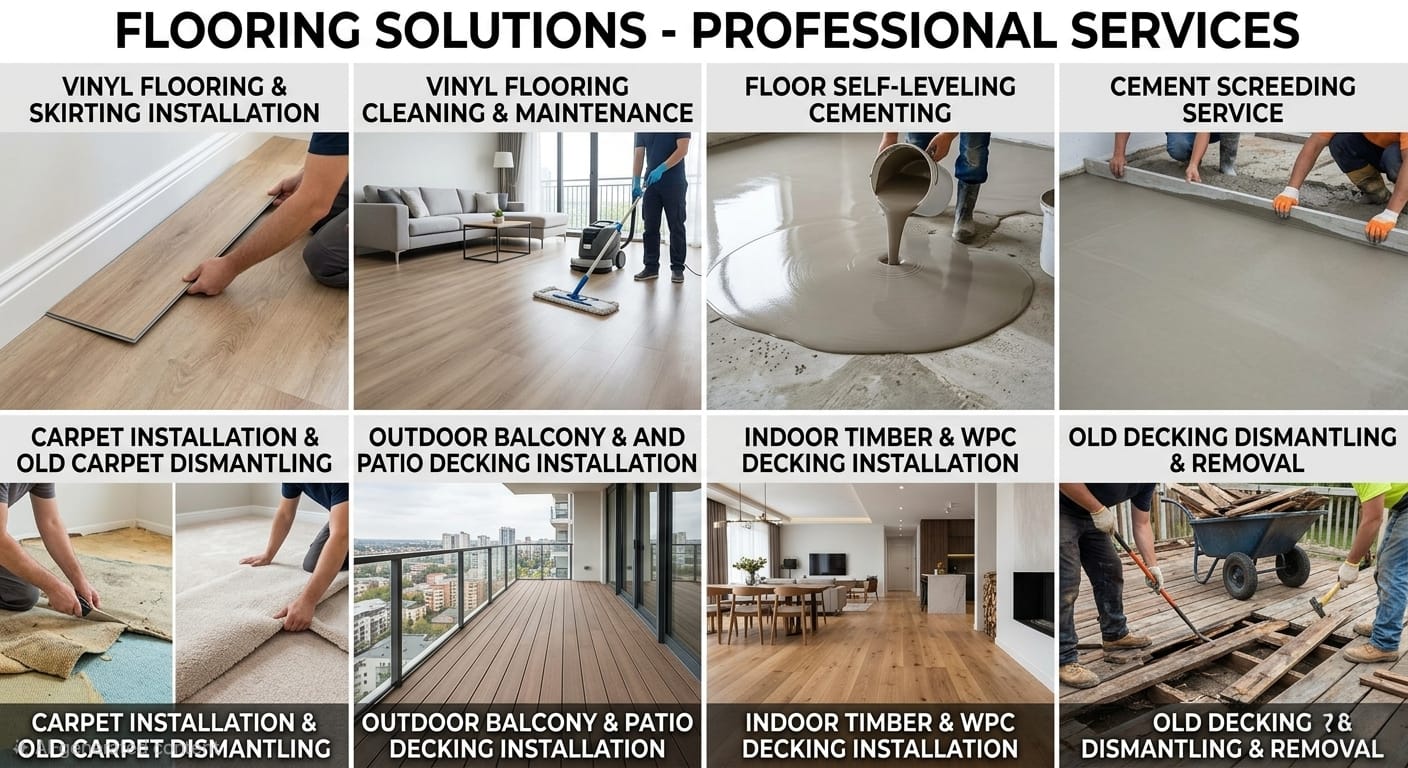
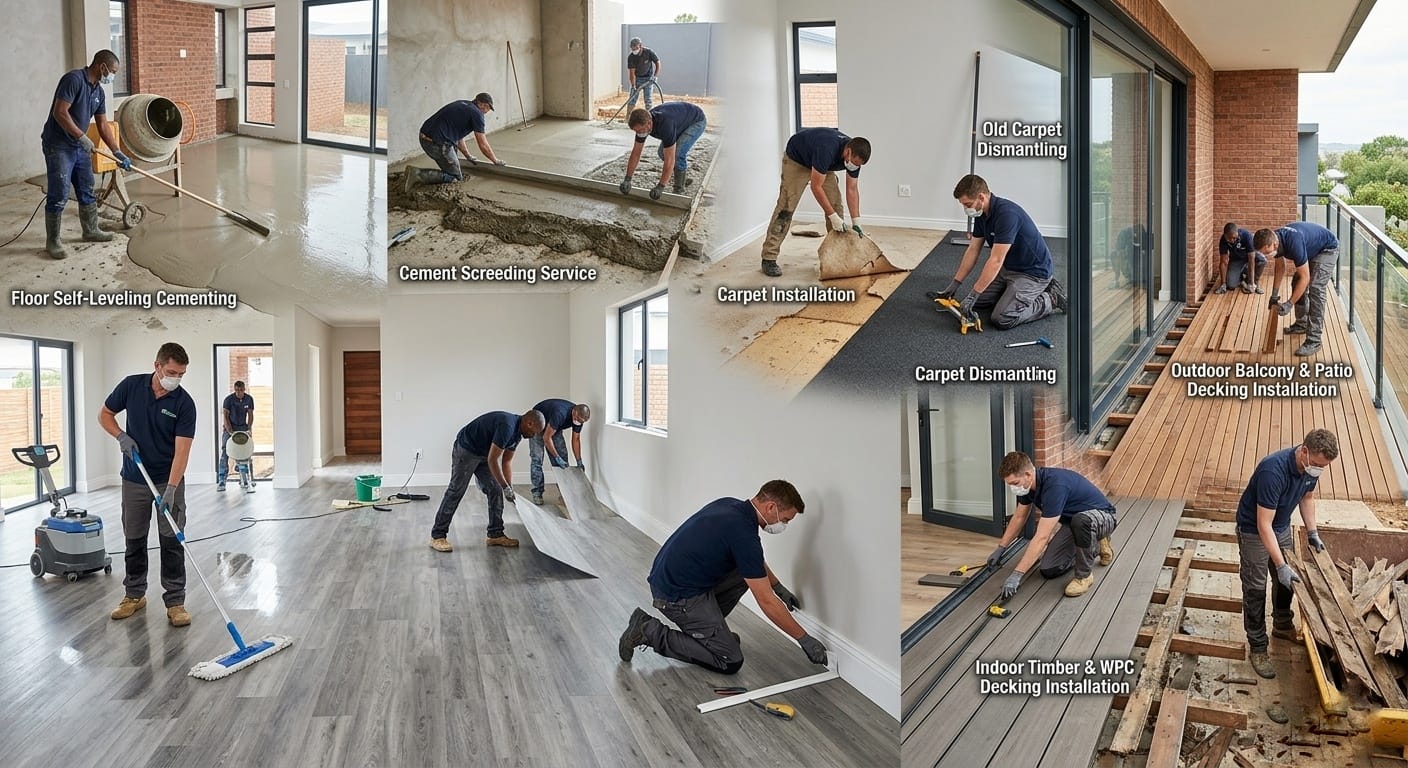
What is Self-Leveling Cementing?
Unlike traditional thick cement screed which must be manually leveled and troweled by hand, self-leveling cement is an advanced, polymer-modified compound with high-fluidity characteristics.
When poured, it behaves like a liquid, spreading rapidly across the room to naturally fill up low spots, hollow dips, and deep pits under the natural pull of gravity. The result is a perfectly flat, smooth-as-glass surface that traditional manual skimming simply cannot match.
Floor Self-Leveling Cementing Services in Singapore
Are you preparing to install brand-new luxury vinyl planks, sleek engineered timber, or large-format tiles? A gorgeous finish starts from the ground up. If your underlying concrete slab is uneven, bumpy, or sloped, your new premium flooring will likely flex, creak, or crack under your feet.
At Flooring Expert SG, we provide professional Floor Self-Leveling Cementing (also known as self-leveling underlayment) across Singapore. We transform rough, uneven concrete subfloors into mirror-smooth, perfectly flat foundations ready for flawless floor installation.
17+
Years of experience
98%
Return Customer
Floor Self-Leveling Cementing Services in Singapore
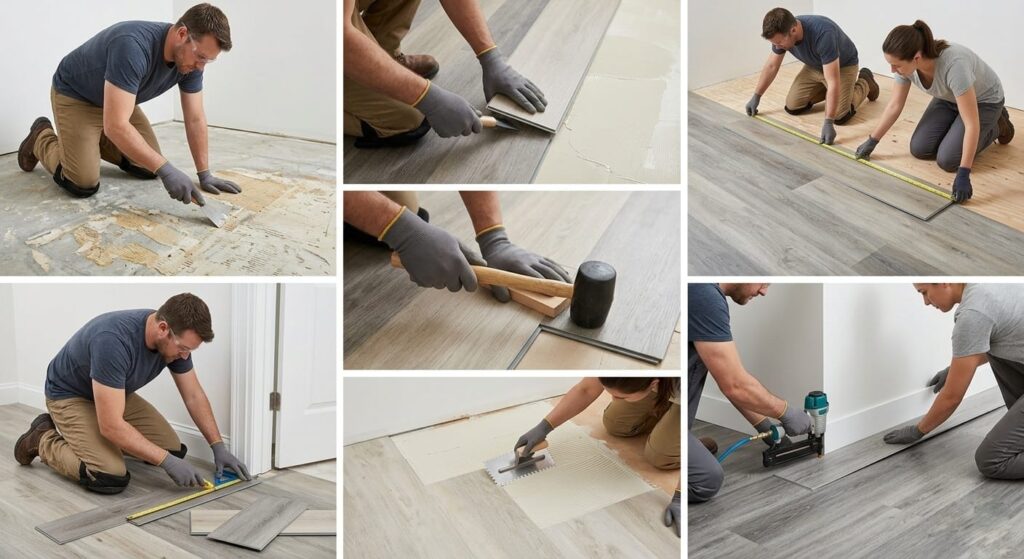
Our Step-by-Step Self-Leveling Process
Achieving a flawless self-leveling pour requires speed, precision, and the right chemical ratios. Our certified team follows a strict sequence to ensure success:
We mechanically grind down major high spots, remove old paint, oil, or tile adhesive residues, and thoroughly vacuum away all microscopic dust particles.
We patch structural concrete cracks and seal any expansion gaps or perimeter edges. This prevents the liquid cement from leaking into structural cavities or down to neighboring units.
We apply a specialized concrete bonding primer. This seals the porous raw concrete to prevent air bubbles (pinholes) from rising into the fresh self-leveling mix and ensures maximum adhesion.
Using heavy-duty industrial mixers, we blend the self-leveling powder with exact water ratios. We pour the high-flow liquid sequentially, using a gauge rake and a spiked roller to release trapped air.
The advanced polymer compound cures rapidly. Within 4 to 24 hours (depending on room ventilation), the subfloor is completely walkable and ready for your final flooring layout.
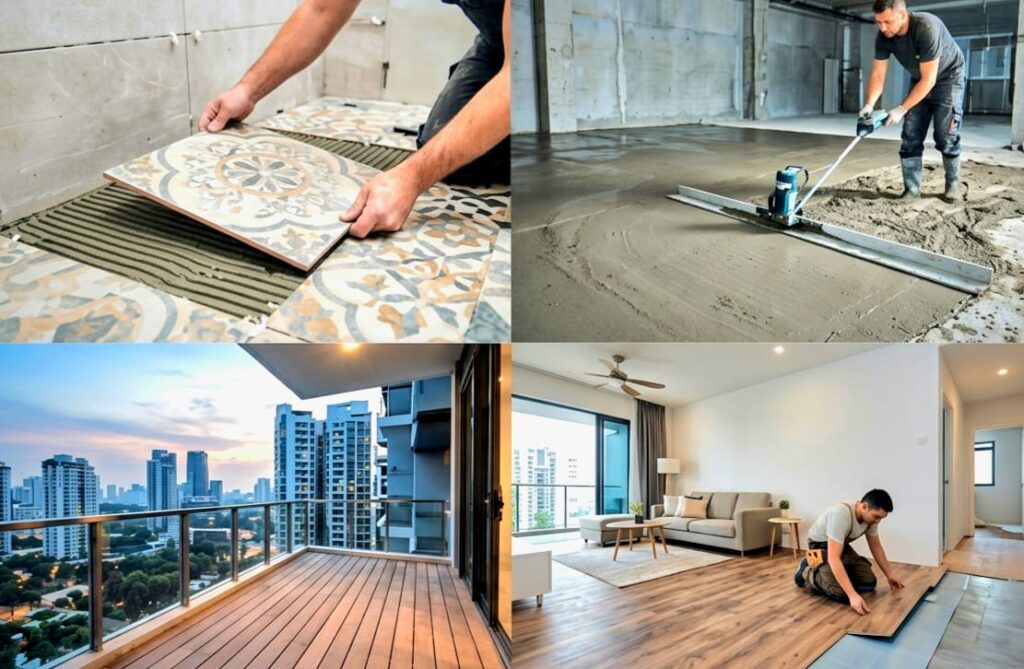
Why Choose Flooring Expert SG?
- Advanced Equipment: We use industrial-grade mixers and spiked aeration rollers to eliminate structural pinholes and weak points.
- Experienced Craftsmanship: Self-leveling sets incredibly fast. Our teams work with absolute precision to ensure the liquid is distributed perfectly before it cures.
- Flawless Integration: Because we handle both subfloor prep and final vinyl/timber layouts, we guarantee your finished floor will look beautiful and feel solid underfoot.
Why Self-Leveling is Crucial Before Flooring
01
Prevents Click-Lock Failure: Floating vinyl planks require a flat surface. Dips in the subfloor cause planks to bounce when stepped on, eventually breaking the delicate interlocking click joints.
02
Eliminates Hollow Sounds: Fills the air gaps beneath the flooring, eliminating annoying hollow clicking or squeaking noises when you walk.
03
Saves Money on Adhesive: For glue-down vinyl or parquet, a perfectly smooth floor requires significantly less glue and guarantees an unbreakable bond.
Frequently asked questions
1. What exactly is self-leveling cement, and how does it differ from normal cement?
Traditional cement screed is a thick, dry sand-cement mixture that must be manually troweled, smoothed, and sloped by hand. Self-leveling cement is an advanced, polymer-modified liquid compound. When poured, it behaves almost like water, naturally flowing into low spots, filling dips, and using gravity to create an ultra-flat, mirror-smooth surface that manual smoothing simply cannot replicate.
2. How do I know if my flat or office actually needs self-leveling cementing?
If your raw concrete subfloor has waves, minor dips, ridges, or an unevenness greater than 3mm across a 2-meter radius, self-leveling is highly recommended. You can usually tell if you need it if your current floor has noticeable high and low spots, or if your existing click-lock vinyl planks bounce, squeak, or feel hollow when you walk on them.
3. Can self-leveling cement fix major sloping issues or change floor heights?
No. Self-leveling cement is designed as a thin-coat underlayment (typically applied between 2mm to 10mm thick) to eliminate surface unevenness and rough textures. It follows the natural slope of the structural slab. If you need to raise a room's floor level by several centimeters, correct massive structural drops, or create a drainage slope in a balcony or bathroom, you will need our heavy-duty Cement Screeding Service instead.
4. How long does it take to dry, and when can my new flooring be installed?
One of the greatest benefits of modern self-leveling cement is its rapid curing time. It is usually firm enough to walk on within 4 to 6 hours after pouring. However, before laying down moisture-sensitive materials like luxury vinyl planks, engineered wood, or parquet, we strictly let the compound cure for 24 hours to ensure all structural moisture has evaporated safely.
5. Is the self-leveling process dusty or smelly? Will it affect my neighbors?
The mixing and pouring processes are completely liquid, meaning there is zero airborne dust generated while the cement is going down. We do all heavy mechanical grinding beforehand using industrial dust-extraction vacuums to keep dust to an absolute minimum. The polymer mixtures we use are low-odor and non-toxic, making them completely safe for HDB blocks and occupied commercial buildings. For Commercial Spaces (Offices, Retail, Gyms): Due to high foot traffic and outdoor grit being tracked in daily, we recommend a maintenance schedule of every 3 to 6 months to protect your corporate investment.
Work Image Gallery – Flooring Expert SG
Your Review is very important to us